
Quick Facts
- Open offices boost teamwork but can increase noise and distractions.
- Private offices improve focus and privacy but cost more and feel less flexible.
- Your work style matters most: collaboration-heavy teams differ from deep-focus roles.
- The indoor environment impacts performance, including comfort and productivity.
- Hybrid layouts often win by combining open areas with quiet, private spaces.
What’s In This Guide
Office design has shifted quickly in recent years. Open office layouts became popular because they’re cost-effective, adaptable, and designed for teamwork. But many companies also ran into common tradeoffs, especially more noise, more distractions, and less privacy.
That tension matters because the workplace environment is not just a backdrop. The indoor setting plays a real role in employee comfort, satisfaction, and work performance, which ultimately affects overall productivity.
So which is better: open office furniture or private office furniture?
It depends. Open office furniture is often the better fit when collaboration and fast communication drive results. Private office furniture tends to work best when focus, confidentiality, and uninterrupted work are essential. Many businesses get the strongest outcome by combining both.
Here are the key differences, pros, cons, and best uses to help you choose.
What Is Open Office Furniture?
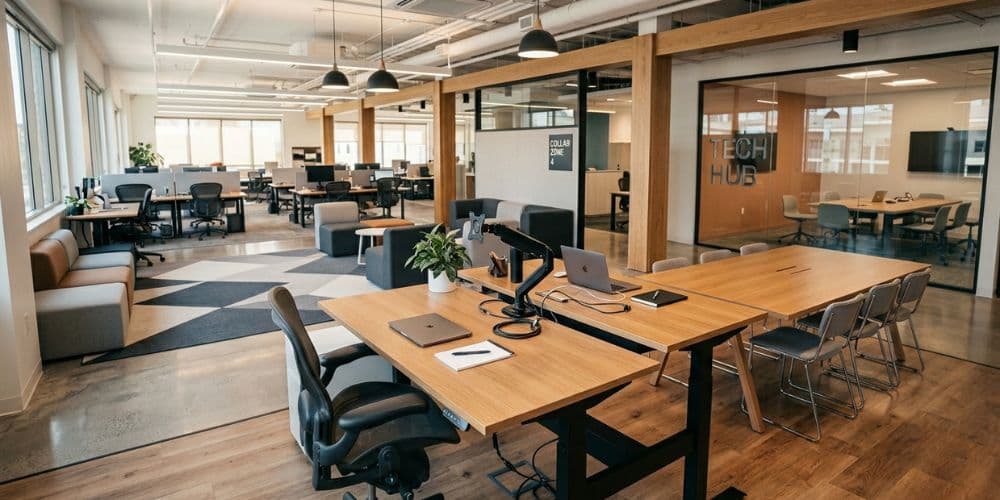
Open office furniture refers to workplace layouts built with few physical barriers between employees. Rather than relying on individual offices or tall cubicle walls, these setups use shared workstations and collaborative furniture to keep teams visible and accessible to one another.
This approach is designed to support day-to-day teamwork, which matters because office employees spend a significant share of their time working with others.
In fact, a survey shows office workers spend about 42% of their time collaborating, so an open layout is often chosen to make those quick conversations, shared problem-solving moments, and informal check-ins easier to do naturally throughout the workday.
Common Types of Open Office Furniture
Several types of furniture help create an open office environment:
- Benching systems: Long desks that allow multiple employees to sit side by side, often facing each other. They maximize workspace efficiency and encourage teamwork.
- Communal worktables: Large tables designed for shared use, often placed in central areas for group collaboration.
- Shared desks or hot desks: Workstations that employees use as needed instead of having permanently assigned seating.
- Low-panel workstations: Desks with short partitions that provide some separation without blocking visibility or communication.
- Modular collaborative furniture: Flexible seating arrangements such as movable desks, lounge seating, and breakout areas that support teamwork and informal meetings.
Open Office Furniture: Pros vs. Cons
Open office layouts prioritize collaboration and efficient use of space, but they also come with tradeoffs that can affect focus and privacy.
|
Pros |
Cons |
|
Better collaboration: Easier communication, faster teamwork. |
Harder to concentrate: Background noise makes sustained attention tougher. |
|
Lower cost: Fewer walls and offices, more seats per square foot. |
Less privacy: Harder to do sensitive work or conversations. |
|
More flexibility: Modular layouts that adapt as teams change. |
Lower work quality: Mistakes can increase when employees are frequently interrupted. |
|
Brighter feel: Better natural light and an open, modern flow. |
Higher stress for some: Constant activity can lead to fatigue. |
Best Uses for Open Office Furniture
Open office furniture works best in environments where collaboration and rapid communication are essential.
Ideal Industries
Certain industries naturally benefit from open workspaces. These include:
- Creative agencies
- Marketing teams
- Technology companies
- Product development teams
- Startup environments
These fields often rely on brainstorming, quick feedback, and frequent collaboration between departments.
Work Types That Benefit Most
Open offices are particularly effective when employees work on projects that require regular interaction. Tasks that benefit from open environments include:
- Collaborative project planning
- Creative brainstorming sessions
- Agile product development
- Team-based problem solving
In these situations, the ability to communicate quickly can improve efficiency and innovation.
What Is Private Office Furniture?
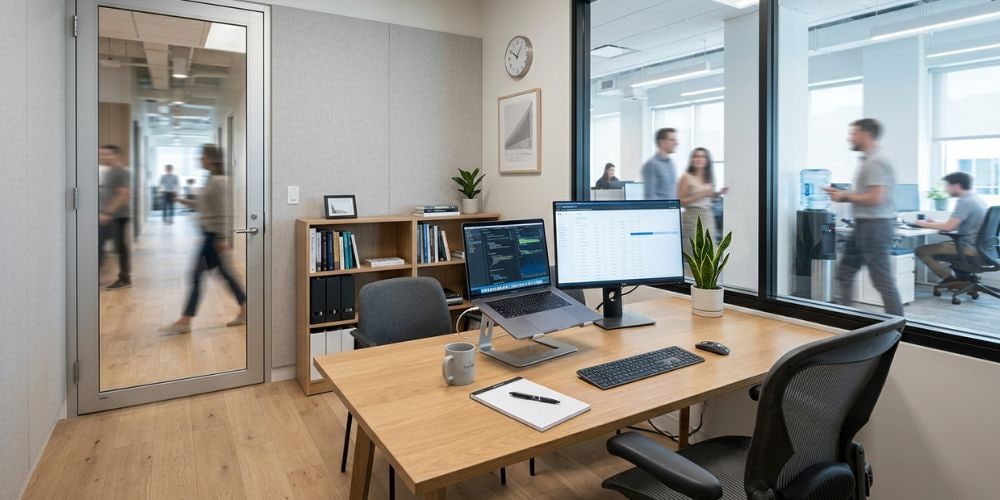
Private office furniture refers to workspace designs that provide individual work areas separated by walls, doors, or tall partitions. Instead of shared workstations, employees work in enclosed offices or high-panel cubicles that offer greater separation from surrounding activity.
This style of office design has been common in corporate environments for decades because it prioritizes concentration, confidentiality, and professional structure.
Common Types of Private Office Furniture
Several types of furniture help create a private, distraction-reduced office environment:
- Enclosed private offices: Traditional rooms with doors, typically furnished with an individual desk, storage, and guest seating for focused work and confidential conversations.
- Executive desks and casegoods: Larger desks paired with matching storage pieces (credenzas, bookcases, hutches) designed for leadership roles and high-visibility offices.
- High-panel cubicles: Workstations with taller panels that block sightlines and help reduce noise, offering more privacy than low partitions.
- Panel-based partition systems: Configurable wall panels that create semi-enclosed work areas, useful when you need privacy without building permanent walls.
- Private workstations with modesty panels: Individual desks with added front/side panels to improve visual privacy while maintaining a clean, professional look.
- Office pods or focus booths: Standalone enclosed units designed for quiet, heads-down work or private calls in otherwise open floor plans.
- Task seating for focused work: Ergonomic chairs built for long periods of seated concentration, often paired with adjustable desks and monitor arms for comfort and posture support.
Private Office Furniture: Pros vs. Cons
Private office setups create quieter, more controlled workspaces, though they may reduce flexibility and increase overall costs.
|
Pros |
Cons |
|
Better focus: Fewer noise and visual distractions. |
Higher cost: More construction, furniture, and space per employee. |
|
More privacy: Supports confidential work and conversations. |
Less collaboration: Can slow communication and create silos. |
|
Personal control: Easier to customize workspace for comfort. |
Less flexible: Harder to reconfigure as teams change. |
|
Health benefits: Less close contact can reduce illness spread. |
More isolation: Some employees may feel disconnected. |
Best Uses for Private Office Furniture
Private workspaces remain essential for many departments and roles.
Departments That Benefit Most
Private offices are especially valuable for teams that handle sensitive information or require quiet environments. These departments include:
- Human resources
- Finance and accounting
- Legal teams
- Executive leadership
Work Types That Require Privacy
Certain tasks demand minimal interruption and strong confidentiality. These include:
- Contract negotiations
- Financial analysis
- Personnel discussions
- Strategic planning
- Research and data analysis
In these situations, privacy directly supports productivity and professionalism.
Open Office vs. Private Office Furniture: Key Differences
The differences between open and private office furniture can be summarized across several key factors.
|
Feature |
Open Office Furniture |
Private Office Furniture |
|
Collaboration |
High |
Low |
|
Concentration |
Low |
High |
|
Privacy |
Low |
High |
|
Cost |
Lower |
Higher |
|
Flexibility |
High |
Lower |
Neither layout is universally better. Each approach supports different types of work and organizational needs.
How to Choose the Right Office Furniture Layout for Your Business
Choosing between open and private office furniture requires a thoughtful evaluation of how employees work.
Step 1: Evaluate Your Company Culture
Some organizations thrive on collaboration and open communication. Others rely more heavily on individual focus and structured workflows.
Understanding how your teams naturally operate can guide the right layout decision.
Step 2: Analyze Job Functions
Different roles require different work environments. Creative teams often benefit from open collaboration, while analysts, researchers, and financial professionals need quieter spaces.
Mapping out job responsibilities helps determine which areas should remain open and which require privacy.
Step 3: Consider Growth and Flexibility
Businesses expecting rapid growth may benefit from flexible furniture systems that can adapt to changing team sizes.
Modular furniture and open layouts are often easier to adjust than fixed office structures.
Step 4: Assess Privacy Needs
If employees regularly handle confidential information, private workspaces are essential.
Even in collaborative environments, dedicated rooms for private conversations or focused work can be valuable.
Step 5: Factor in Employee Well-Being
Employee comfort plays a major role in workplace productivity. Noise tolerance, personality differences, and preferred work styles all influence how individuals perform in different environments.
Frequently Asked Questions

Are cubicles considered private office furniture?
Cubicles can be considered a form of private office furniture because they provide physical separation between employees. High-panel cubicles help reduce visual distractions and limit noise compared to fully open workstations. While they are not completely enclosed offices, they still create a more defined personal workspace.
Can office furniture influence employee satisfaction?
Yes, office furniture and layout can strongly influence how employees feel at work. Comfortable workstations, adequate space, and reduced distractions can improve daily work experiences. When employees feel supported by their environment, they are often more engaged and productive.
Why is workspace privacy important for some roles?
Certain roles involve sensitive information or tasks that require uninterrupted focus. Employees working in legal, financial, or human resources roles often need private environments for confidentiality. Privacy also helps employees concentrate on detailed or analytical work.
How often should businesses review their office layout?
Office layouts should be reviewed whenever business needs or team structures change. Growth, new departments, or shifts in work style may require adjustments to the workspace. Periodic evaluations help ensure the office still supports productivity and employee comfort.
How can businesses balance collaboration and privacy?
Balancing collaboration and privacy often requires a mix of different workspace types. Open areas can support teamwork, while private spaces allow employees to focus when needed. Meeting rooms, pods, and quiet zones help bridge the gap between the two.
Design a Workspace That Supports Both Collaboration and Focus
Office furniture shapes how employees focus, communicate, and stay productive. Open office furniture can support teamwork and flexibility, while private office furniture creates quieter spaces for concentrated work and confidential conversations.
For many businesses, the best answer is balance: open collaboration areas paired with private offices and quiet zones that support different roles and work styles. If you want help planning the right mix, Stamford Office Furniture can recommend practical layouts and furniture solutions that fit your space.
Reach out to Stamford Office Furniture today to get started.