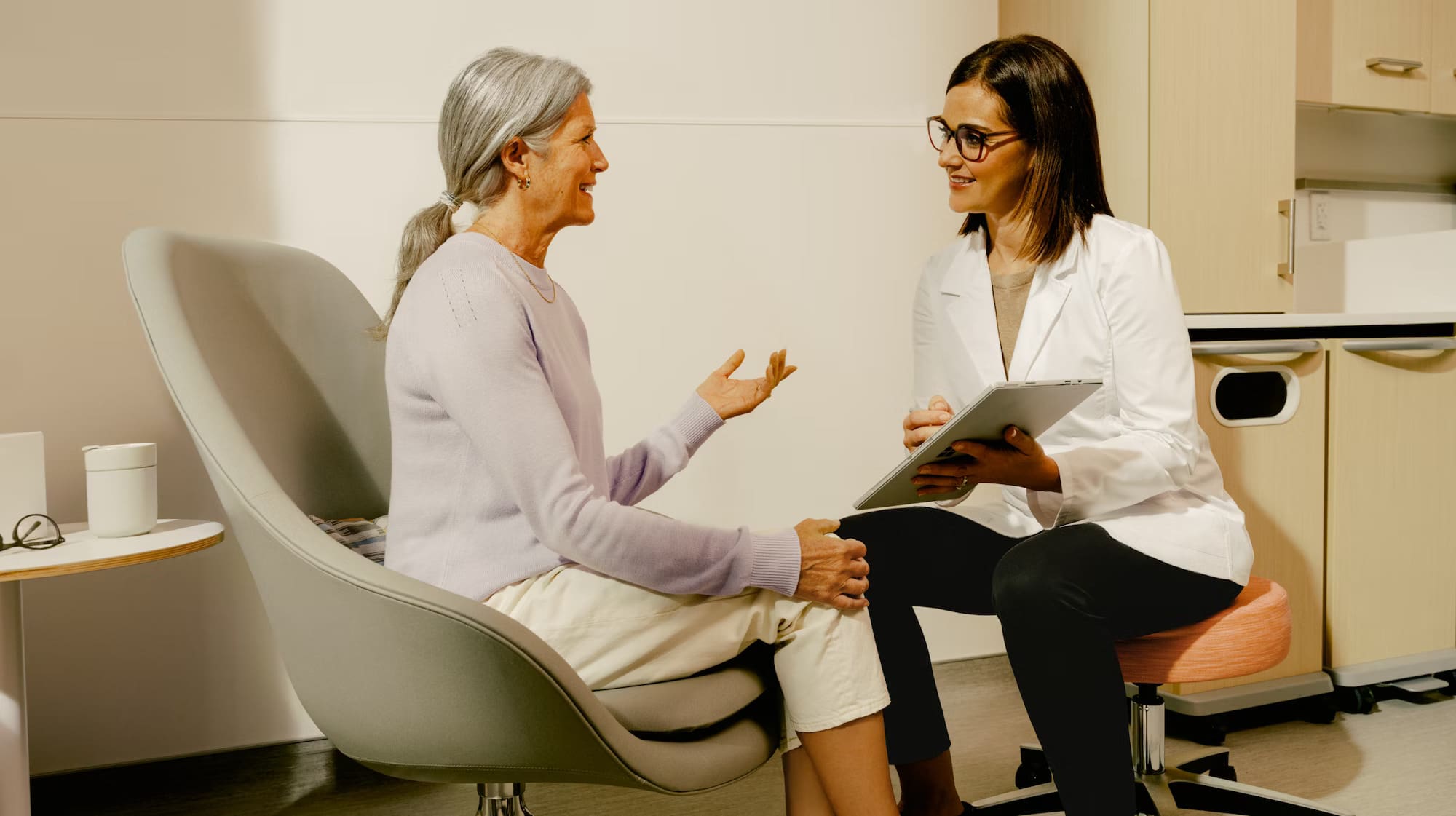
Exam rooms can cause stress for many people, even making it difficult for patients to interact with clinical staff. Design flexible, well-appointed spaces to meet patient and family needs. Create a sense of calm and safety where everyone experiences openness and better focus on care conversations.
37%
37% of adult patients were found to be accompanied to routine medical visits by a family companion, most commonly by a spouse or adult child.*
*Wolff, J. L. & Roter, D. L. (2011) Family presence in routine medical visits: A meta-analytical review. Social Science & Medicine 72, 823–831.
Applications
Design considerations
Read on to learn how you can develop intentional exam rooms with hospitality in your facility.
Protection
Limit visual obstruction from corners or equipment to keep patients and families visible to staff.
Position clinical casework and products to be easily accessed when the clinician enters the room.
Meet facility cleaning requirements with finishes, fabrics, and surfaces.
Visible hand-washing sink.
Intellectual welcome
Reduce stress by hiding exam tools inside casework.
Provide extra seating so guests can help patients understand and retain information.*
Create comfortable exam rooms, functional and decorative, with accessories like coat racks or lamps.
Consider a comfortable recliner when full exams aren’t needed.
Open table
Create spaces that encourage human interaction and relationship building.
Use adjustable tables and same-level lounge seating to allow for more relaxed, face-to-face conversations.
**Kenton Unruh, et al. “Transforming Clinic Environments into Information Workspaces for Patients,’ Proc SIGCHI Conf Hum Factor Comput Syst. 24 (2010): 183–192
Contact SOF today and let’s discuss how we can make your workplace one that meets the need of your employees, and that helps drive results.